Community infrastructure – thinking beyond delivery and into lifecycle
Published on 06 July 2026
By Sebastian Del Rosso, Category Manager
Across Queensland, parks, open spaces and recreation facilities play a critical role in shaping liveable, connected and resilient communities. From regional playgrounds and sports fields to the urban green corridors and coastal spots that many people hold close to their hearts; these assets are essential to wellbeing, economic activity and environmental sustainability.
However, we see too often that infrastructure is approached as a capital project with a defined endpoint when being delivered. Community infrastructure is a long-term investment that must be actively managed across its entire lifecycle. This includes from initial planning right through to renewal and/or repurposing.
Adopting of lifecycle approach enables councils to move beyond short-term delivery outcomes and instead focus on sustainable, value-driven asset management that meets the evolving needs of their communities.
The lifecycle approach to community infrastructure
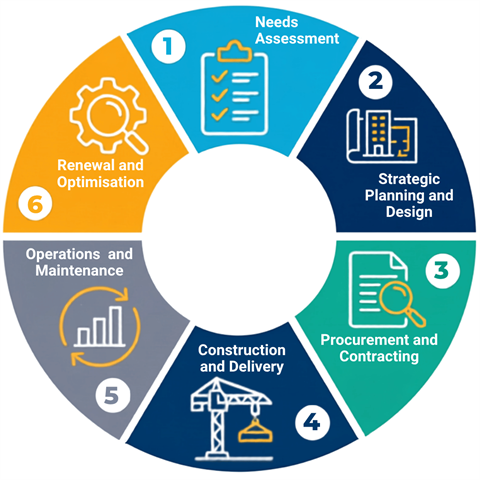
The infrastructure lifecycle can be broadly understood across six interconnected phases:
- Needs Assessment
- Strategic Planning and Design
- Procurement and Contracting
- Construction and Delivery
- Operations and Maintenance
- Renewal and Optimisation
Decisions made at each stage directly influence the next, with early planning and procurement choices having long-term implications on performance, cost and usability.
This could result in negative consequences such as:
- Poor upfront planning leading to underutilised or misaligned infrastructure,
- low-cost delivery decisions resulting in higher long-term maintenance expense, and
- inadequate maintenance planning could lead to the acceleration of assets deterioration.
Councils that embed a lifecycle methodology into their approach are better positioned to deliver assets that are fit-for-purpose, cost-efficient and responsive to the needs of their community over time.
The community need
The lifecycle begins long before the shovel hits the dirt. Councils must first understand what infrastructure their communities require.
A strong needs assessment should move beyond simply identifying desire but test whether a project is genuinely required, who it will serve, how it aligns with council strategies and whether it can be delivered, operated and maintained over time.
Councils should be assessing:
- Service gaps
- Future demand
- Equity and access
- Strategic alignment
- Whole of life affordability
- Site suitability and limitations
- Partnership and funding opportunities
- Community value
Those councils that engage with more people, hit these points more consistently than those that do not. Examples of engagement would be consulting with sporting clubs, community groups, residents, and other key stakeholders to understand how best to articulate the problem statement and the options for solutions. In this way, the needs assessment becomes the evidence base for good decision-making rather than just a formality at the start of a project to tick a box.
From planning into design to deliver community outcomes
Effective networks of parks and open spaces begin with evidence-based planning and are designed around real user experience. Councils should consider how people will want to arrive, move through, gather, participate, supervise others, rest, play, feel safe and connect at all different times of the day and year within the space.
Increasingly councils are balancing:
- Urban densification and access to green space
- Health and wellbeing outcomes
- Climate resilience and environmental stewardship
- Inclusive and accessible design
Design decisions should also be tested against the original need and the future operational realities. Materials used, finishes, integrated systems such as irrigation, lighting, drainage etc should all be selected with durability, safety, repairability and local maintenance capability in mind.
To best enable councils entering this phase, LB335 Planning, Survey and Designs allows for qualified professionals across urban planning, engineering, surveying, landscape architecture, environmental services, and community engagement. The Arrangement has been set up to help develop robust business cases, master plans, concept designs, and technical documentation that set projects up for long-term success.
Turning design into reality
Transforming a plan and expectations into visible, physical assets can often be a daunting task. For councils, this is often the most publicly scrutinised part of the infrastructure lifecycle as residents will see the project take shape before their eyes.
Community infrastructure projects should however not be measured only by whether it was completed on time and on budget, but also on whether the project was properly planned, scoped, coordinated and tested before construction begins.
The more disciplined a council is before works commence, the less likely it is to face costly variations, redesign, delays, and stakeholder dissatisfaction. This stage can challenge councils and having a trusted partner can be essential to a successful delivery phase.
Local Buy offers two distinct pathways to help support at this stage:
- LB304 Public Facilities and Parks is our flagship Arrangement for the delivery and renewal of parks, open spaces, public amenities, and community facilities across the board. It has been designed to offer suppliers that can efficiently create and maintain attractive, safe and functional public spaces.
- LB303 Sport and Recreation supports the development and enhancement of sporting and recreational infrastructure, providing access to specialist suppliers capable of delivering these facilities that encourage sport participation, support healthy communities and meeting evolving user expectations.
Long term performance of assets
Completion of the build and its activation for the community begins the phase of maintenance and operations.
Routine maintenance activities may include:
- Playground inspections and repairs
- Sports field maintenance and turf management
- Cleaning of public amenities
- Landscaping and vegetation management
- Asset condition inspections
- Lighting and electrical maintenance
- Graffiti removal
- Pathway and furniture repairs
This is where the initial conceptualisation and design of the project is really challenged, with early decisions and plans needing to be robust enough to successfully sustain the infrastructure against its intended usage.
LB303 and LB304 provide strong access to capable suppliers to maintain sites but additionally, LB305 Landscape and Gardening is a go-to procurement pathway to maintain and enhance the natural and landscaped environments that have been invested in. It includes those horticultural services, grounds maintenance, environmental enhancement work and other usability and presentation work that are key to community wellbeing.
A whole-of-life approach to community infrastructure
The most successful councils view community infrastructure as assets that they are stewards of and the call to action of this article is to ask councils to consider the full journey of an asset before committing to investment. A whole-of-life approach recognises that decisions made at the needs assessment and design style can influence how much as asset costs to build as much as how it valuable it serves within the community over time.
Keeping track of key monitoring requirements on assets within the community can be an uphill battle as they grow and change over time. LB347 Asset Management has been designed specifically to serve councils with a panel Arrangement of suppliers that can deliver optimised asset management services with specialised advice, tech solutions, assessments and support.
Moving from reactive maintenance to proactive evidence-based asset management solutions give councils a clearer line of sight over whole of life costs. Instead of waiting for assets to fail or relying on customer complaints, councils can use structured information to prioritise investment by clear justifications in budget bids, stage out renewal programs effectively (making procurement more effective in bringing value to the table) and linking technical asset information to practical decisions about service delivery, risks and community value.
Procurement as a strategic lever
Procurement plays a central role across every stage of the lifecycle, yet it is often viewed primarily as a compliance function focused on tendering and contracting. In practice, procurement is a strategic enabler that influences:
- Design quality and innovation
- Supplier capability and performance
- Risk allocation and contract outcomes
- Whole-of-life value for money
Early engagement with procurement teams assures councils take a more holistic view of value; balancing the costs, quality, sustainability and risk across the lifecycle. This can be challenging when supplier capability and capacity is low within the council area, and you need a quality team of suppliers to help deliver the initiative.
Across both metropolitan and rural to remote communities, many face shared challenges including:
- Low supplier capability and capacity within the council area
- Increasing complexity of infrastructure projects
- Growing community expectations on infrastructure
- Budget and funding constraints
Aggregated procurement models like Local Buy help to address these challenges by providing:
- Access to broader supplier markets
- Standardised procurement pathways
- Reduced duplication of effort
- Opportunities for innovation and collaboration
Local Buy Arrangements help ensure that all councils, regardless of size or location, can deliver consistent, high-quality outcomes for their communities. All our Arrangements have pre-agreed terms ready to go, or you can utilise your own council’s terms and conditions – there is flexibility in how you can contract. Read about our Flexibility Framework here.
For your council’s next community infrastructure initiative, consider using these Local Buy Arrangements:
For more information on this Arrangement, please contact Category Manager, Sebastian Del Rosso sdelrosso@localbuy.net.au